As reported on November 12, 2026, the Bitcoin Security Consortium, in a report prepared with Presidio Bitcoin, argued that quantum computing poses a specific risk to Bitcoin: a sufficiently capable machine running Shor’s algorithm could derive a private key from an exposed public key. No computer capable of doing that to Bitcoin’s signatures had been demonstrated at the time of the report.
Where is the exposure?
The report distinguishes two possible attacks. In a long-exposure attack, a public key is already visible, as with reused addresses or older pay-to-public-key (P2PK) outputs. Project Eleven estimated that about 7.1 million BTC, roughly 35% of the total, would be exposed if a capable quantum computer existed. The report says about three-quarters of that amount sits in reused addresses, largely at major exchanges. Moving funds to fresh addresses could reduce that exposure.
The report also puts about 1.8 million BTC in P2PK outputs, many of which are presumed lost and may be impossible to move. In its discussion of possible responses, it gives a narrower figure of about 1.7 million BTC across roughly 20,000 P2PK addresses, including an estimated 1.1 million BTC attributed to Satoshi Nakamoto. These are estimates, not a count of coins known to be recoverable or lost.
An in-transit attack would target a transaction after it reveals a public key but before it enters a block. Google estimated that a hypothetical, prepared quantum device could derive a key in as little as nine minutes. That is a calculation about a possible machine—not a demonstrated theft or a fixed window for every transaction.
What can be done?
Avoiding address reuse does not require a Bitcoin rule change. A longer-term response would be a post-quantum signature scheme, but that remains under development. The report identifies Blockstream’s SHRINCS as a leading proposal. Blockstream tested it on Liquid in March 2026, and a Bitcoin improvement proposal followed in August. Its formal security proof was still pending, and deploying it across Bitcoin would require a soft fork. The report cites an estimated capacity of up to three transactions per second for SHRINCS, versus 0.36 for the NIST-standard SPHINCS+ scheme; neither figure describes an enacted Bitcoin upgrade.
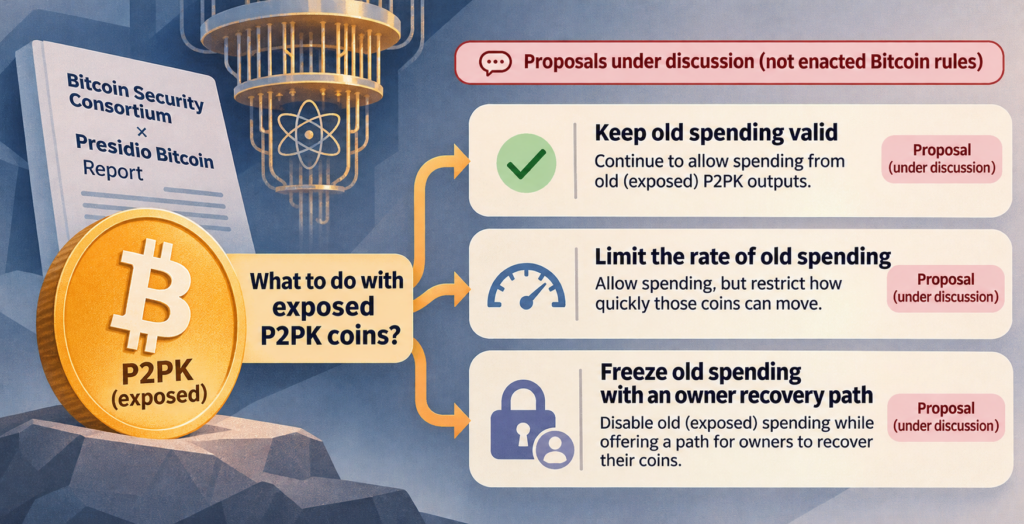
The harder question is what to do with exposed P2PK coins that may no longer have owners able to move them. Presidio Bitcoin described three options under discussion: leave old spending valid, limit how quickly those coins can move, or freeze old spending while offering owners a recovery path. No consensus choice is presented in the report.
Quantum research makes preparation worth discussing, but research designs are not working attacks. The report says the best demonstrated system had 48 error-corrected logical qubits, against an estimated minimum of about 1,200 for breaking Bitcoin’s elliptic-curve signatures. Its central limitation is therefore clear: reducing today’s avoidable exposure is possible, while the timing of a capable machine—and the rules Bitcoin might adopt for the remaining coins—remains uncertain.