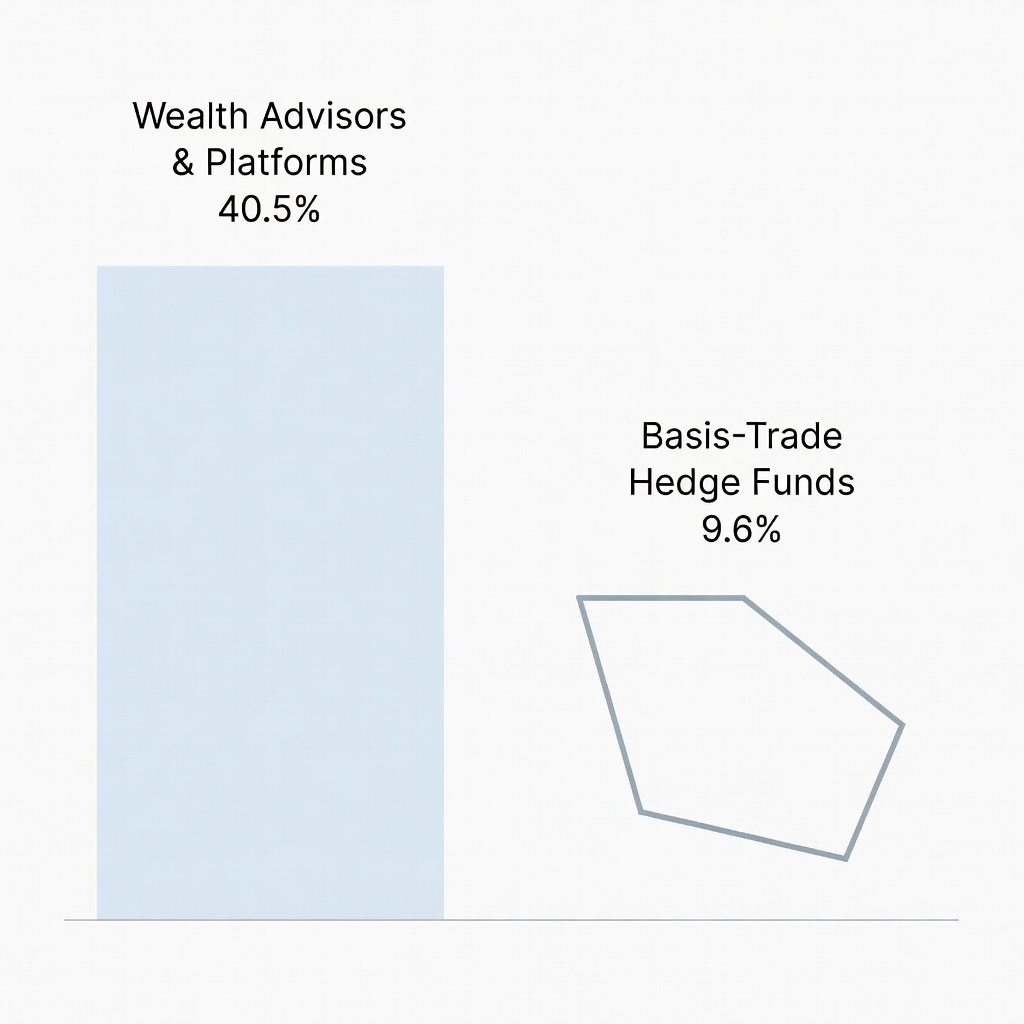
Who holds the largest reported slice of the institutional Bitcoin ETF market?
Galaxy Research’s reading of third-quarter 2026 SEC Form 13F filings puts wealth advisors and wealth platforms at a record 40.5% of reported institutional Bitcoin ETF shares, more than any other group in those filings. The same group held 144,307 BTC-equivalent as of September 30, 2026. A year earlier it accounted for 24.3% of reported institutional holdings. Galaxy’s figures show nine consecutive quarters of increases, and a position 3.3 times the level recorded in March 2024.
The hedge funds that once dominated these filings are a much smaller share. Basis-trade hedge funds are 9.6% of reported holdings, down from 33.9% in March 2024. The broader hedge-fund category fell to 19.0% of reported Bitcoin ETP holdings in the third quarter of 2026, from 50.6% at the end of 2024.
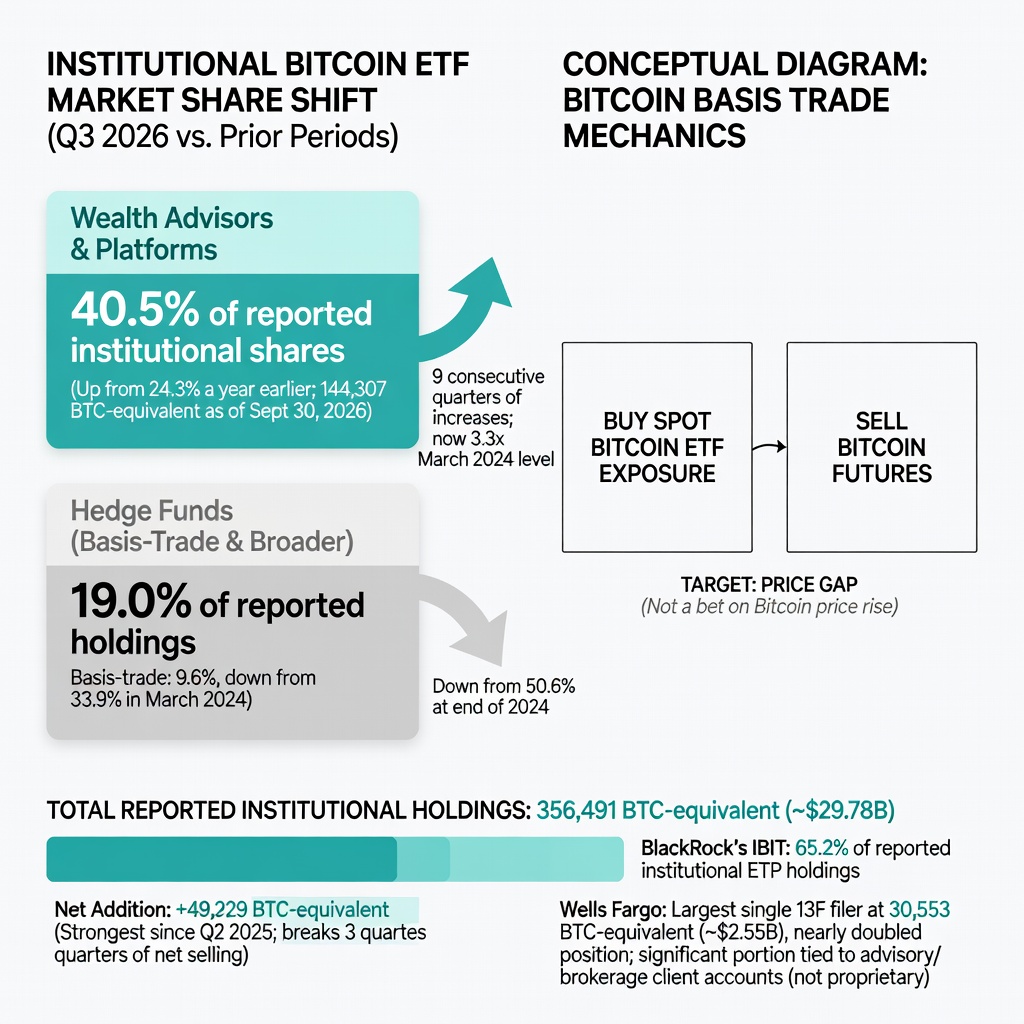
A basis trade is not a bet that Bitcoin’s price will rise. The fund buys spot exposure, often through an ETF, and sells Bitcoin futures at the same time. The target is the gap between those two prices.
Across 13F filers, reported institutional holdings were 356,491 BTC-equivalent, about $29.78 billion. Filers added a net 49,229 BTC-equivalent in the quarter. Galaxy describes that addition as the strongest since the second quarter of 2025, and as the break in three consecutive quarters of net selling.
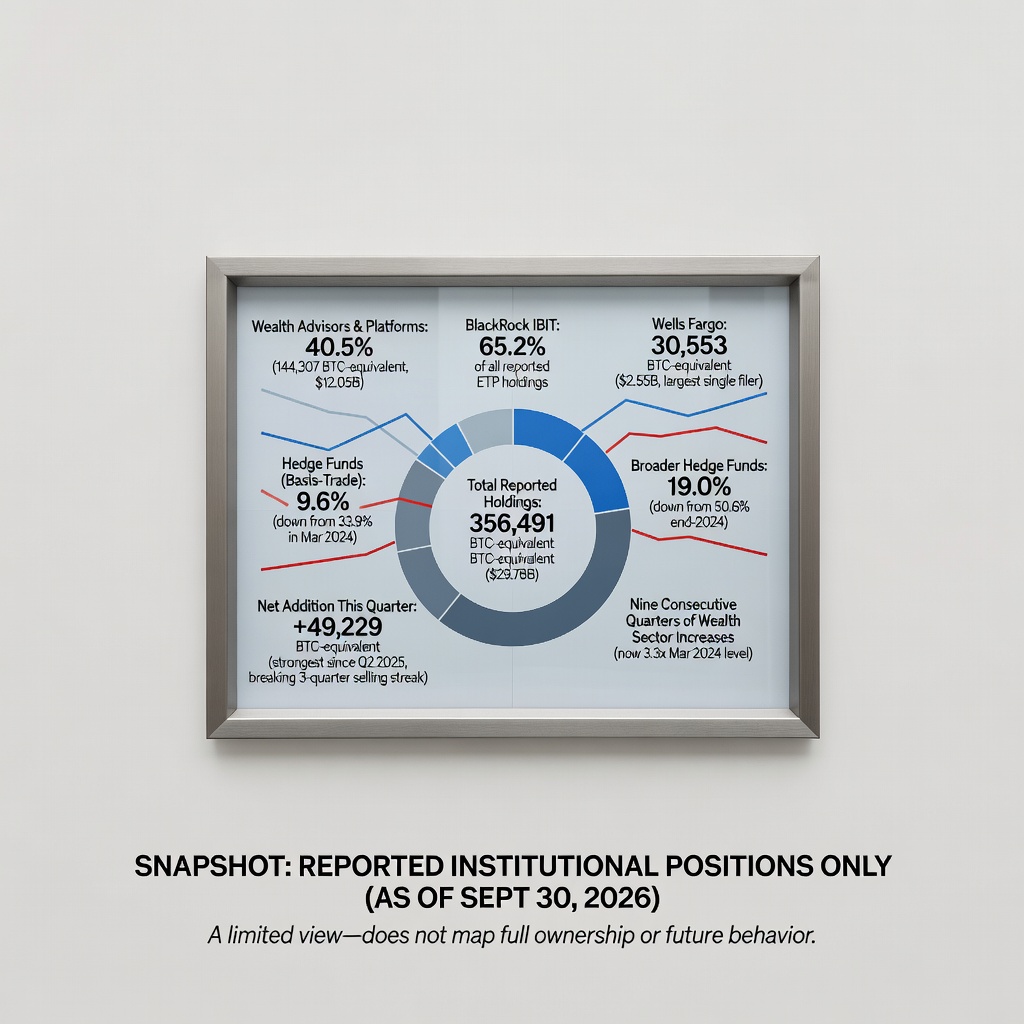
BlackRock’s IBIT accounted for 65.2% of reported institutional Bitcoin ETP holdings. Wells Fargo nearly doubled its reported position to 30,553 BTC-equivalent, about $2.55 billion, and became the largest single 13F filer for the first time. A significant portion of that position is tied to advisory and brokerage services, so much of the exposure appears to sit in client accounts rather than a proprietary bank trade. That is an inference from how the filing is described, not a full look-through of every account.
Galaxy characterizes the wealth-management buying pattern as “sticky,” because the sector kept accumulating through periods of market volatility. That describes past filings. It does not establish how the next quarter will behave. With one product and a few large platforms carrying so much of the reported book, a change in advisor access at a major bank could move a large amount of recorded demand. Whether the nine-quarter streak continues, whether other large banks follow Wells Fargo, and whether hedge-fund holdings stabilize are questions for the next round of filings, not facts already in hand.
The limit is in the form itself. A 13F covers certain institutional managers and only the positions held at quarter-end. It is a snapshot of reported Bitcoin ETF and ETP holdings, not a complete map of who owns the funds, and not a map of who owns Bitcoin.