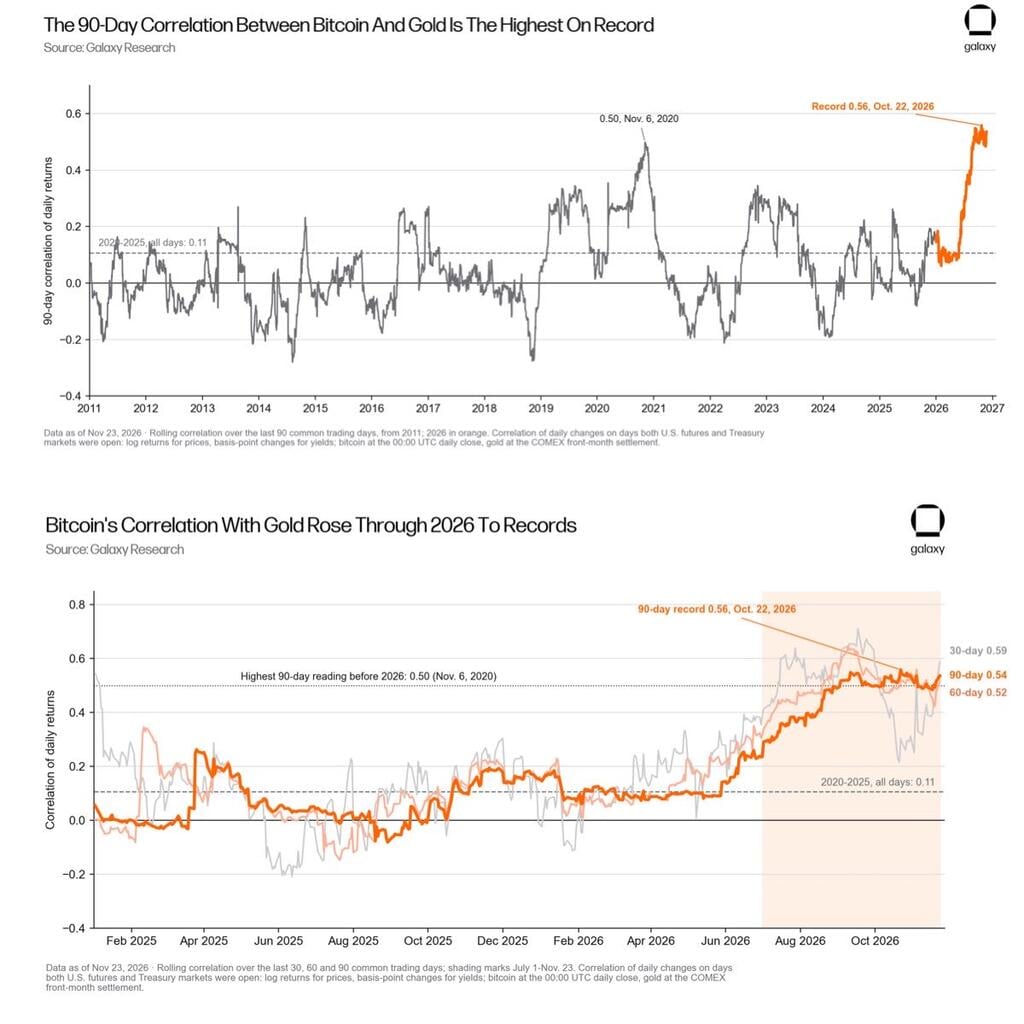
Bitcoin and gold moved more closely together over the 90 days ending Oct. 22, 2026, than in any previous 90-day period in Galaxy Research’s data. Their correlation reached 0.56, above the previous record of 0.50 set on Nov. 6, 2020. By Nov. 23, the reading had eased to 0.54, still above the old record.
The shift began in July. Bitcoin’s 90-day correlation with gold had stayed near 0.1 through the first half of 2026, close to its 2020–2025 average of 0.11. By early October it had climbed above 0.50. The measurement period matters: Galaxy’s charts, shared on Nov. 27 by Alex Thorn, head of firmwide research at Galaxy Digital, showed a 30-day correlation of 0.59 on Nov. 23. That was a separate measure, not a new 90-day high.
The record speaks to one part of the “digital gold” comparison: how closely the two prices moved during a particular period. In February, Thorn had argued that Bitcoin’s failure to trade like gold since September 2025 had weakened that comparison for newcomers. But he distinguished the original claim about Bitcoin’s fundamental properties from an expectation that its price would amplify gold’s moves. In January, Galaxy CEO Mike Novogratz had interpreted gold’s price as a sign that the U.S. was losing reserve currency status at an accelerating rate, while noting that Bitcoin was still meeting selling pressure.
A record correlation did not settle the bear-market question
On Nov. 25, Galaxy withdrew its Oct. 26 assessment that Bitcoin’s bear market had ended in June. Bitcoin closed the week ending Nov. 22 at $61,104 after seven consecutive weekly losses. At that point, the decline from its October 2025 record had lasted 412 days, longer than the 163 to 406 days Galaxy measured for earlier bear markets. Yet the price decline, at 53%, was smaller than the losses of 77% to 93% in those earlier periods.
Only two of Galaxy’s 13 indicators of a market bottom had been met. The firm also reported that U.S. spot Bitcoin exchange-traded products held about 1.24 million BTC, down 71,339 BTC since Oct. 4. Asked by SkyBridge Capital founder Anthony Scaramucci at the Digital Assets Forum in New York on Nov. 17 whether Bitcoin could return to $90,000 by year-end, Novogratz called it unlikely.
Thorn identified $58,525, Bitcoin’s June 30 closing low, as the threshold in Galaxy’s assessment. In his view, a daily close below it would signal a move to a materially lower low. Galaxy cited about $48,500 and $28,200 as possible lows if the June low broke. Those were conditional scenarios, not outcomes predicted by Bitcoin’s correlation with gold.