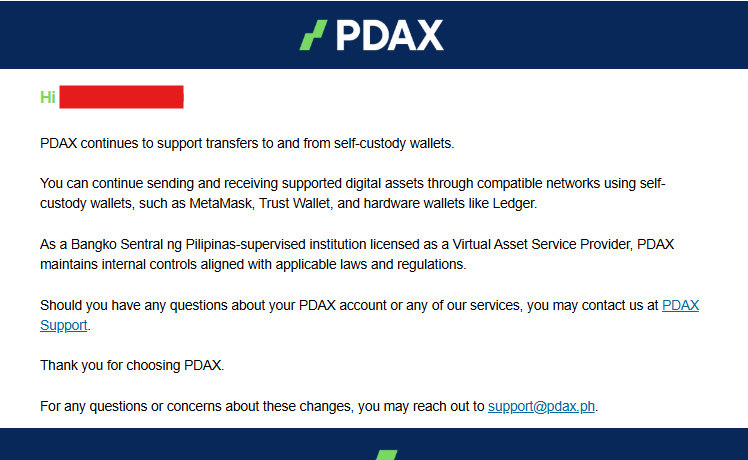
Customers of the Philippine Digital Asset Exchange (PDAX) can still withdraw crypto to a wallet they control or deposit crypto from it, the licensed exchange said in a customer email reported on November 28, 2026. The policy covers supported assets on compatible blockchain networks. PDAX named MetaMask, Trust Wallet and Ledger as examples.
Where the two exchanges differ
On November 19, Coins.ph stopped direct transfers to and from self-custody wallets. It limited external crypto deposits and withdrawals to accounts at other regulated exchanges and required Travel Rule disclosures for every transfer. In a November 24 statement, Coins.ph described the restriction as its “risk-based” implementation of Travel Rule standards set by the Bangko Sentral ng Pilipinas (BSP).
BSP Circular No. 1108 and Memorandum No. M-2023-042 require licensed virtual asset service providers to conduct sanctions screening and enhanced due diligence on unhosted wallets. Coins.ph attributed its decision to those standards. PDAX, also a BSP-supervised provider, said its internal controls comply with applicable Philippine laws and regulations while allowing personal wallet transfers.
How PDAX handled stablecoin-funded bond purchases
Separately, about 1,200 local retail investors used stablecoins on PDAX to buy roughly $1 million of the Philippine Bureau of the Treasury’s Retail Dollar Bonds Tranche 3 during the November 19–24 offering. The three-year bonds carry a 5.65% annual coupon, and the offering raised about $1.3 billion across all distribution channels.
Stablecoin-funded subscriptions averaged $750 per investor, above the $200 minimum. Investors used USD Coin, Tether, Western Union’s USDPT and Ripple’s RLUSD. The stablecoins funded the purchases but did not settle the bond orders: PDAX Securities Inc., the exchange’s licensed broker-dealer subsidiary, converted them to U.S. dollars and settled the orders in the Treasury’s National Registry of Scripless Securities.