
Historical report: originally published November 12, 2026, at 17:31 (UTC+8).
Why would a Bitcoin miner sell its BTC while moving away from mining? In its review of nine publicly listed miners’ third-quarter results, Blockhead found that three already earned more than half their revenue outside mining. It reported that others were selling BTC held on their balance sheets to help fund a shift toward AI data-center services.
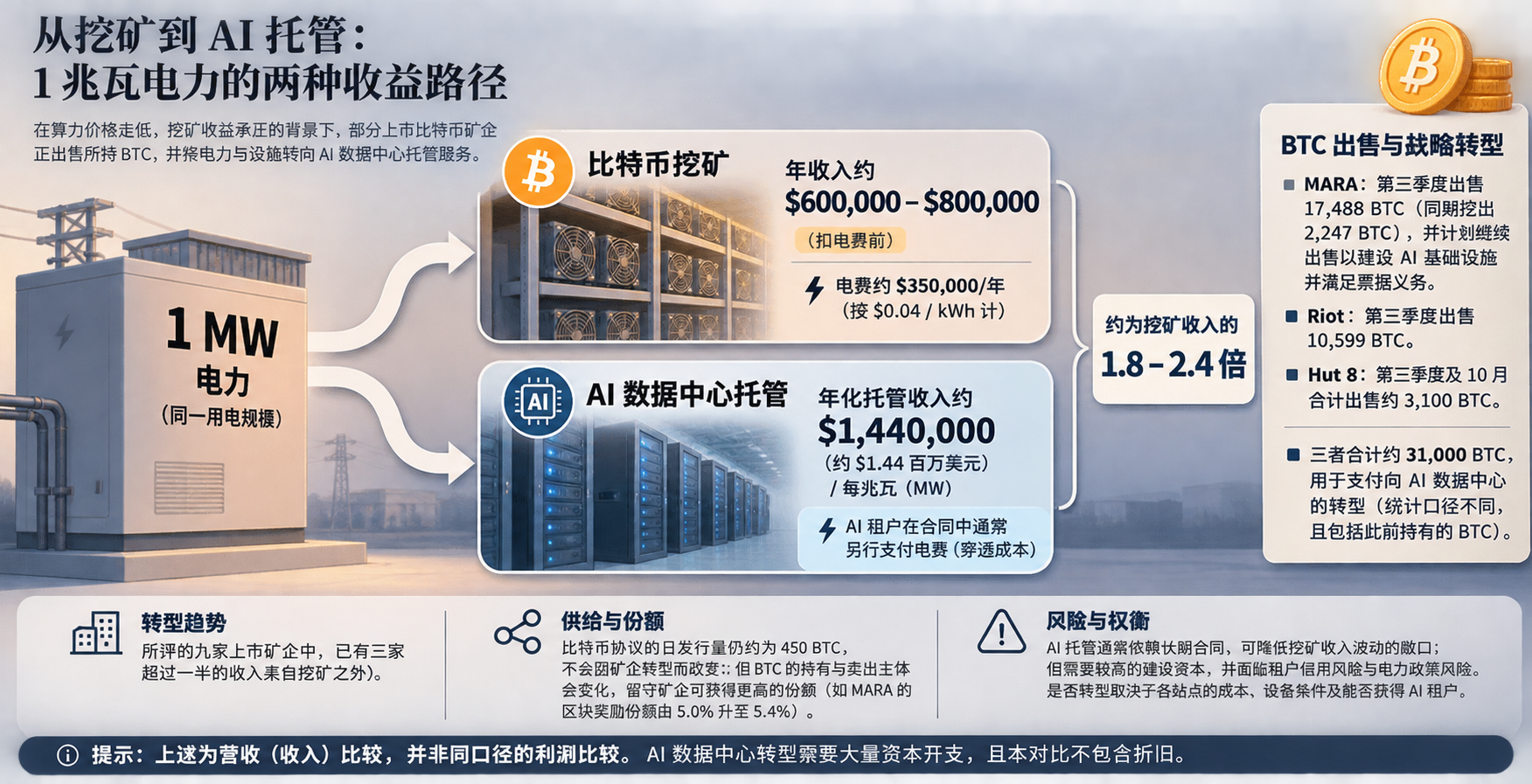
What changes the calculation for one megawatt?
According to MillionMiner data cited by Blockhead, hashprice—the daily mining revenue per PH/s of computing power—fell from $40.24 on October 1 to $33.18 at the end of October, a 17.5% decline. Blockhead estimated that, at roughly $33 hashprice and the equipment efficiency it specified, one megawatt used for mining would generate about $600,000–$800,000 a year before roughly $350,000 in electricity costs at $0.04 per kWh.
By contrast, Core Scientific reported more than $700 million in annualized hosting revenue from 485 MW of billable capacity. That works out to about $1.44 million per MW annually, or roughly 1.8–2.4 times Blockhead’s estimated mining revenue per MW. These are not like-for-like profit figures: data-center conversions require substantial capital, and the estimate excludes depreciation. Blockhead also noted that AI tenants commonly pay electricity separately under their contracts.
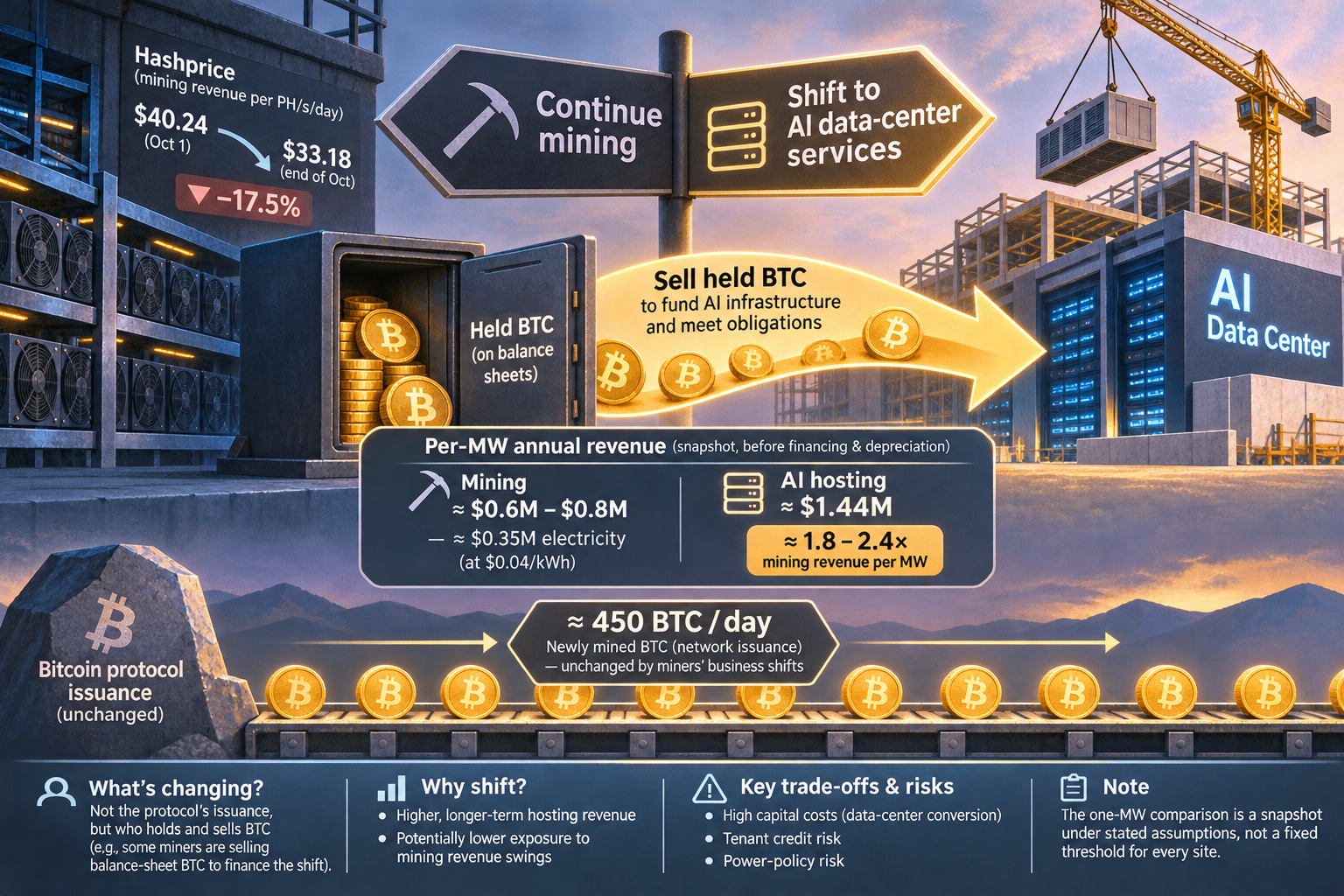
What do the BTC sales show?
MARA said it sold 17,488 BTC in the quarter, compared with 2,247 BTC mined, and planned further sales to finance AI infrastructure and meet note obligations. Riot sold 10,599 BTC in the third quarter. Hut 8 sold about 3,100 BTC across the third quarter and October. Together, those sales were about 31,000 BTC, though the reporting periods differ and the totals include previously held coins—not just newly mined BTC.
The protocol’s issuance of roughly 450 BTC a day does not change because a miner switches businesses. What can change is who holds and sells BTC. Blockhead also reported that MARA’s share of block rewards rose from 5.0% to 5.4% as its energized computing power grew 18%, illustrating how remaining operators can gain share.
The trade-off is not a guaranteed improvement in returns. Long-term hosting contracts may reduce exposure to changing mining revenue, but they bring construction costs, tenant credit risk and power-policy risk. Blockhead’s one-megawatt comparison is a snapshot under stated assumptions, not a fixed threshold at which every mining site should convert: the outcome depends on each site’s costs, equipment and ability to secure an AI tenant.
Source: techflowpost.com (originally published 2026-11-12 17:31 UTC+8)