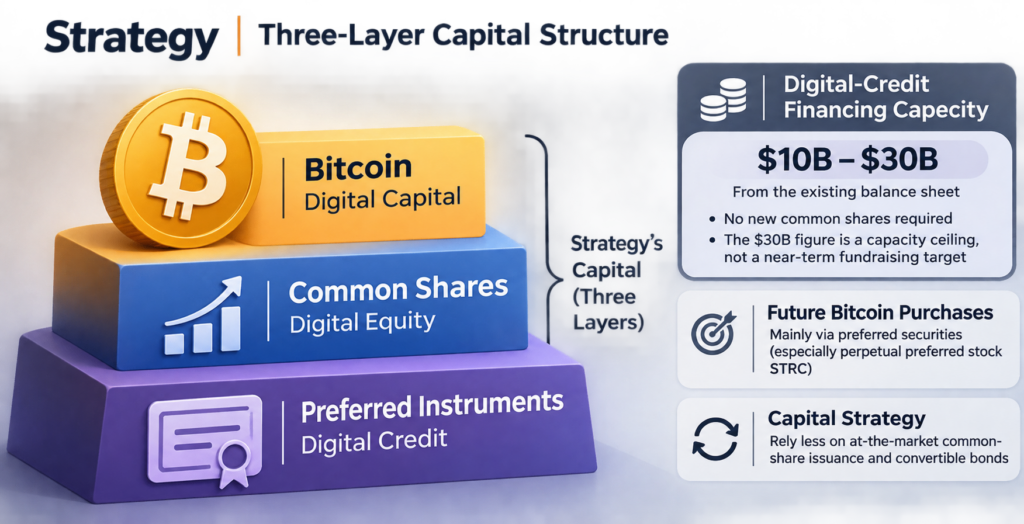
In a report dated November 15, 2026, Strategy executive chairman Michael Saylor proposed creating $10 billion to $30 billion in digital-credit financing capacity from the company’s existing balance sheet. He said the plan would not require issuing more common shares or a further rise in Bitcoin’s price. The $30 billion figure was a capacity ceiling, not a near-term fundraising target.
CEO Phong Le said Strategy’s main route for future Bitcoin purchases would be preferred securities, particularly the perpetual preferred stock STRC. As described in the report, these securities have no fixed maturity or voting rights. Their dividends are fixed and take priority over payments to common shareholders; STRC is designed to offer a double-digit yield.
The balance-sheet context matters. As of October 25, 2026, Strategy held 848,517 BTC, up 26% year to date. It had about $5.07 billion in U.S.-dollar assets, which the company said could cover preferred dividends and debt interest for roughly 3.4 years. Third-quarter net income was $19.53 billion, driven mainly by $20.91 billion in digital-asset gains. Its existing digital-credit securities had a notional value of $16 billion across 10 listed instruments.
Strategy describes its capital in three layers: Bitcoin as digital capital, common stock as digital equity, and preferred instruments as digital credit. It is seeking to rely less on at-the-market common-share issuance and convertible bonds. The distinction is that proposed financing capacity is not money already raised, and the reported dividend coverage is not a guarantee of future coverage.