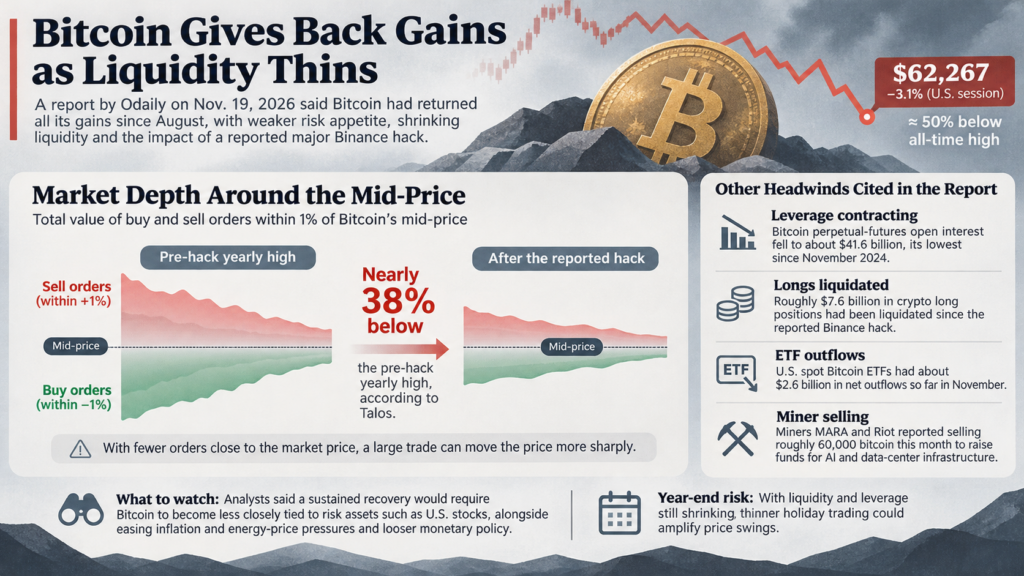
What changed? In a report published on November 19, 2026, Odaily said Bitcoin had given back all its gains since August amid weaker risk appetite, shrinking liquidity and the impact of a reported major Binance hack. Bitcoin briefly fell below $63,000 on Wednesday and ended the U.S. trading session down 3.1% at $62,267—about 50% below its all-time high.
Why does liquidity matter? Talos data showed that the total value of buy and sell orders within 1% of Bitcoin’s mid-price was nearly 38% below its high for the year before the reported hack. With fewer orders close to the market price, a large trade can move the price more sharply.
Leverage was also contracting. Bitcoin perpetual-futures open interest had fallen to about $41.6 billion, its lowest since November 2024. Since the reported Binance hack, roughly $7.6 billion in crypto long positions had been liquidated.
Other reported flows offered little support. U.S. spot Bitcoin ETFs had seen about $2.6 billion in net outflows so far in November. Miners MARA and Riot reported selling roughly 60,000 bitcoin this month to raise funds for AI and data-center infrastructure investment. Glassnode said investors who had bought Bitcoin in the preceding six months took profits during the September–October rebound and were again facing pressure to sell at a loss.
Jasper de Maere, an over-the-counter trader at Wintermute, said the rally from July’s low may have been a false breakout, with no clear support from ETF flows, digital-asset treasury companies, retail buyers or institutions. Analysts cited in the report said a sustained recovery would require Bitcoin to become less closely tied to risk assets such as U.S. stocks, alongside easing inflation and energy-price pressures and looser monetary policy. Those are conditions to watch, not a forecast: with liquidity and leverage still shrinking, thinner year-end holiday trading could amplify price swings.