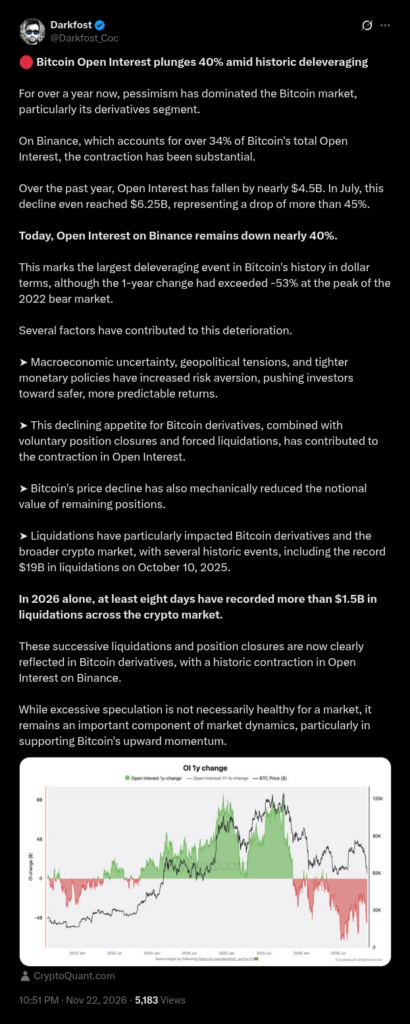
Over the year into late November 2026, Bitcoin traders on Binance reduced open interest by about 40%, or roughly $4.5 billion. CryptoQuant analyst Darkfost called that dollar decline the largest deleveraging event in Bitcoin history.
Open interest is the total value of derivative contracts still outstanding. A falling number means traders are closing positions faster than they open new ones. Binance accounted for more than 34% of total Bitcoin open interest, and Darkfost treated that share as a stand-in for speculative demand across venues.
The decline was uneven. In July, open interest shrank by $6.25 billion, more than 45%. Some positions later returned, but the trend did not reverse. When Darkfost posted the figures on November 22, 2026, Binance open interest had fallen over the month from $10.6 billion to $8.8 billion, a 17% drop, and had moved below its 180-day moving average. On Monday, November 23, as positions unwound after Nvidia said co-founder Jensen Huang would again take the roles of president and chief executive, the decline reached almost $4.7 billion.
A lower Bitcoin price also cuts the dollar value of contracts that remain open. The notional total therefore falls for two reasons: positions are closed, and the bitcoin those contracts reference is worth less. In percentage terms the one-year change was larger at the height of the 2022 bear market, when Darkfost said it was more than 53%. The 2026 move was larger in dollars.

Darkfost said investors were seeking safer returns amid macroeconomic instability, geopolitical unrest, and tighter monetary policy. Closures came from both forced liquidations and voluntary exits. Binance liquidations were $1.4 billion in August, $1.1 billion in September, and $1.3 billion in October, its heaviest months since 2021. In the wider cryptocurrency market, at least eight days in 2026 saw more than $1.5 billion liquidated. Those days followed the record $19 billion wipeout on October 10, 2025.
Leverage that remained could still move the price quickly. After the Nvidia news on November 23, Bitcoin rose above $64,000 and then fell back below $61,000. Coinglass figures showed that jump wiped out about $377 million of cryptocurrency shorts in an hour, of which about $180 million were Bitcoin shorts. The squeeze followed a weekend decline that pushed prices toward $55,000 and cleared bullish bets. In this November 24, 2026 report, Bitcoin was at $61,495, up 0.9% over the prior 24 hours. Cryptopolitan said analysts were watching the $60,000 area as a place where the sell-off might stop or continue into the $50,000s. That is a range of views, not a settled outcome.
Spot holdings were also reduced. Through November 20, $4.14 billion had left U.S. spot Bitcoin ETFs during November.
Dollar open interest mixes closed positions with the effect of a cheaper coin, so it does not by itself show how many contracts remain. Darkfost’s reading was that excessive speculation does not necessarily benefit markets, even though it can still help push Bitcoin higher. A thinner derivatives book removes some of that push, and some of the liquidation risk that comes with it, without changing Bitcoin’s supply or the rules of the network.